Showing posts with label Mumbai. Show all posts

Friday, March 06, 2009

Growing demand for Rahman’s tunes

The tunes of AR Rahman has been relished by music lovers from ‘Roja’, ‘Mumbai’, ‘Gentleman’, ‘Donga Donga’, ‘Rangeela’, ‘Indian’, ‘Prema Desam’, ‘Jeans’, ‘Taal’, ‘Sakhiya’, ‘Lagaan’, ‘Amrutha’, ‘Naani’, ‘Jodhaa Akbar’, ‘Yuvraaj’ to ‘Ghajini’ and the endless list goes on..
Rahman’s double Oscar glory is surging in the country and the demand for his albums in the market is now raging high with patrons thronging towards the stores.
Within this past two weeks, the sales have gone up by more than thirty percent. Store dealers have ordered extra copies of the albums ‘Bombay Dreams’, ‘Signature Collections’, ‘Vandematharam’, ‘Live in Dubai’ and ‘Between Heaven and Earth’. 
The signature tune of Airtel is on air all over India depicting Rahman’s stature and sale records are in a never-seen-before consign in the twin cities of Hyderabad and Secunderabad. Along with movie albums, patriotic and international albums are emptying the stocks, as said by retailers.


Courtesy: indiaglitz.com

Wednesday, March 26, 2008

Daddy’s girl out to prove herself

EVEN as he is busy with the release of his Tamil film Dasavatharam, Kamal Haasan has started work on his next project Marmayogi that is set in the seventh century.

To be made in Tamil, Telugu, Hindi and Malayalam, his fourth directorial film is being produced by Walt Disney Productions in collaboration with Bharatbala Productions and Adlabs. Also starring Hema Malini, it has music by AR Rahman.

Meanwhile, the numero uno actor will be seen in 10 diverse roles in Dasavatharam that is set for release in April. Asin and Mallika Sherawat are the female leads, with music by Himesh Reshammiya.


What was amazing to see was that despite being tied up with work, the superstar made a fleeting visit to Mumbai recently to be with his elder daughter.

Shruti Haasan performed at Mumbai’s Hard Rock Cafe during the launch of Rolling Stone magazine, where she belted out her own compositions.

She is also making her acting debut in a Tamil film, being directed by Nishikant Kamat and starring Madhavan. That's one proud father all out to support his daughter in her attempt to prove her talent.

Courtesy: newindpress.com

Thursday, February 14, 2008

Dressing up Jodha and Akbar

Dressing up the stars is a piece of cake for fashion designer Neeta Lulla (right).

She has been in the film industry for two decades and won a National Award for her designs in Sanjay Leela Bhansali's Devdas.

Her latest assignment is designing for the Ashutosh Gowarikar's epic love story, Jodhaa Akbar. What makes the fashion designer's job easier is that she is no stranger to one of the stars, Aishwarya Rai Bachchan, whom Neeta has been designing for, in the last decade.

Neeta Lulla talks to Patcy N about Jodhaa-Akbar's elaborate outfits:

Though I have worked on period films like Devdas, Kisna and even a Hollywood film, One Night with the King, Jodhaa Akbar is one of the most challenging films I have ever done in the last 20 years.

One of the main reasons is because this is the first time I have designed for an entire cast -- from Hrithik Roshan and Aishwarya, to a commoner walking on the road.

What made it easier was that everything was well researched. Even then, I worked on this project for a year and half because there was very little information available about the costumes and jewellery worn during that period.

Gowarikar made things smooth. I am yet to come across a director like him who is so organised, calm and in sync with what the technicians are looking for.

I wasn't nervous while doing the film. I thrive on challenges and Jodhaa Akbar was one project that really excited me.

I designed the clothes myself. The accessories, however, were tricky so Tanishq (a leading jewellery brand) stepped in and gave me inputs. Gowarikar also gave me inputs. The accessories were made of gold, cut diamond, ruby, kundan and jade.

As the Mughal era was known for its grandiosity, we used a lot of warm tones though we were careful not to go overboard.

The costumes and accessories were quite heavy but the actors took it in their stride.

I share a great bond with Aishwarya. I have been designing for her for the last decade so I knew her likes and dislikes.

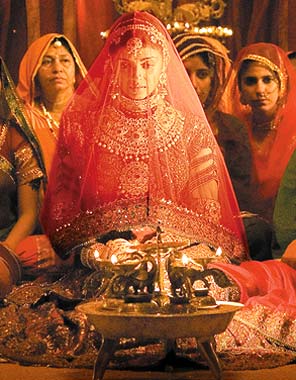
The most ornate costume I designed for Aishwarya in the film is her bridal dress as well as the one she wore for a celebration song. We chose the colour red for the bridal dress, which had a lot of embroidery. In fact, the grandness of the bridal dress was the ornate embroidery which I designed in detail and was brought to life by my artisans.

We got the fabrics from Delhi, Jaipur, Mumbai and Rajasthan.

We used a lot woven fabrics and different textures like brocades, silks and cotton. We used a lot of zardozi, kundan and stones embedded in the embroidery. We also had gotta work done on some of the costumes.

For shoes, we got authentic embroidered mojris from Rajasthan.

Hrithik found it difficult to handle so much ornate work. I don't think anyone would like to wear so much ornate stuff.

I also kept in mind the character while designing the clothes. For example, I used a lot of dark tones of brown, black and green while designing for Nikitin Dheer's negative character.

The jewellery used in Jodhaa Akbar go back to the days of age-old traditions, but with a few modifications.

People may love the accessories of those grand days when they see them in the film but at the same time wearing them in real life is not feasible. People may not be able to afford them.

Plus, more and more people are looking for comfort as well as fashion. So, what I was aiming at is a blend of both -- bringing back the grandness of those days in today's time zone.

Courtesy: Rediff.com

Sunday, February 10, 2008

Hopeful Gowarikar has a lot riding on Mughal-era epic

In this digital age, few challenges are as daunting as making an authentic historical romance that will work its magic at the box office.

The last person to try it, Akbar Khan, learnt that to his detriment two years ago with Taj Mahal. The following year JP Dutta’s version of Umrao Jaan bit the dust, and in recent times the only title to gain acceptance was the remastered version of K Asif’s Mughal-e-Azam, a 1960 original that was re-released in 2004 and took many by surprise.

It’s worth remembering that Asif needed 10 years to make that career-defining film. So, has Ashutosh Gowarikar, who took just over a year to complete his magnum opus, been over-ambitious or will Friday’s release, Jodhaa Akbar, buck the trend?

If early indications are anything to go by, the director of Lagaan and Swades has positioned himself to do what no one else has done with any measure of authority for well over three decades — since HS Rawail’s 1974 release Laila Majnu — and that is to resuscitate the genre.

The lead pair, Hrithik Roshan and Aishwarya Rai, are as good as they get. Gowarikar says he had joked with them that they would only have to pitch up on set, as they were “the reincarnation of Akbar and Jodhaa”.

The fact that they clicked in Dhoom 2 played no part in his decision to cast them. His mind was made up five years ago when scriptwriter Haider Ali broached the subject. Convincing them was a breeze: all he said to Aish was, “You’ll be my Jodhaa,” and she leapt at the chance; as for Hrithik, Gowarikar told him, “16th century, the Mughals and Akbar,” and that was that.

Besides the dashing lead pair, Gowarikar had other factors in his favour, including AR Rahman’s music score.

Four choreographers, Raju Khan, Ash Kumar, Chinni Prakash and Rekha Prakash, were enlisted for the dance sequences. The latter pair took 15 days to complete one song, the stunning Azeem O’Shaan Shahenshah, in which 1000 dancers in traditional costumes and wielding swords and shields took part.

Add Kiran Deohan’s cinematography and Nitin Desai’s sets, and the opulence so essential to a period piece is certainly in place. Attention was paid to the tiniest details. Top designer Neeta Lulla said the challenge of designing the costumes was “too good to refuse”, and specialist jeweller Tanish was appointed to craft specific pieces.

The movie focuses on a relationship that supposedly altered the course of history. It delves into the political conspiracies of the period and tells of the alliance between the Mughal emperor Jallaludin Mohammed Akbar and Rajput princess Jodhaa. Gowarikar des- cribes it as “a perfect arranged marriage”.

Akbar’s proposal was based not so much on his affection for her but on a desire to expand his empire eastward from Afghanistan to the Bay of Bengal, and south from the Himalayas to the Godhavari River. Love developed later.

His strategy to achieve this expansion was to win over the Rajputs, and this marriage with a motive helped him to remove the bitterness and distrust the native Hindus felt towards the invading Mughals, and that, in turn, softened the Mughals’ attitude towards them.

This led to Akbar establishing deen-e-elahi, or the divine faith, to reconcile the sectarian differences that divided his subjects by suggesting that no single reli- gion had a monopoly on the truth.

Jodhaa was not merely a pretty wallflower. A fiery Rajput who was skilled in the art of sword-fighting, she wasn’t an easy conquest and she refused to be a political pawn in Akbar’s designs to capture her land.

Gowarikar enlisted scholars and historians from New Delhi, Aligarh, Lucknow, Agra and Jaipur to scrutinise the script, and while he has acknowledged exercising a measure of creative licence, that did not prevent his detractors from voicing their objections.

The Rajput Sabha demanded the right to approve his script, fearing gross distortions. The Sabha contends that Gowarikar is wrong in stating that Jodhaa Bai was the daughter of the ruler of Amer, Bharmal, since historical records show only one Jodhaa Bai, who was the daughter of the ruler of Marwar, Udai Singh, and who was married to Akbar’s son, Jahangir.

The director hopes he’ll get away with it by suggesting that his story is about a chapter that “may” have been a part of history but was not officially recorded.

He maintains there is enough evidence to show that Akbar the Great had a very special attachment to Jodhaa Bai and that the period referred to was when they were between the ages of 18 and 26, and was therefore not documented.

There have been other problems for Gowarikar. An animal anti-cruelty organisation has questioned whether he had the necessary permits to shoot scenes with elephants, camels and horses.

Shooting at some of India’s famous monuments proved another hurdle. India’s Archaeological Society, which maintains these landmarks, imposed so many conditions that Gowarikar had to get his art director, Nitin Desai, to re-create attractions like the palace of Fatehpur Sikri and the Red Fort in Karjat on the outskirts of Mumbai.

Courtesy: Thetimes.co.za