
Two years ago, Mughal-e-Azam, the K Asif classic, had a second innings. In style. It burst into colour, enjoyed nostalgic reviews and headed for the UK and the US. The 2008 film, Jodhaa-Akbar, is headed — nowhere. Madhya Pradesh and Bihar followed Rajasthan in banning it. For the first time, perhaps, historical validity has become the mainstay of a film controversy.
Jodha, who existed more in folk memory than between the covers of history books, first made her silver screen debut as Akbar’s wife in Mughal-e-Azam, which was released without a disclaimer. No one raised a stink — then. “It probably affronts the contemporary consciousness of Rajput society which is imbued with Hindu consciousness today, irrespective of what happened or did not happen in the past,” reasons Bhagawan Josh, a history professor in JNU. If story telling is an art, that art has its politics.
During the genre’s heyday, till the 1960s, historicals have ridden on artistic licence. Recent films like Subhash Chandra Bose and Gandhi My Father, raised the heckles from few corners. Mangal Pandey (2005), whose bravery has always been contentious, drew some flak. The film even saw unknown local groups like Mangal Pandey Suraksha Samiti spring up. Says Sharmistha Gooptu, editor of Revisiting 1857: Myth, Memory and History, “Though 1857 has been the subject of seven films, only Mangal Pandey created a furore.” Jodhaa though has been the queen of controversy. Why? One explanation is, as Josh says: “Women are the social skin of a community.”
It’s in the plot
Historicals, from the very first feature film, Raja Harischandra (1913), have always been an important genre of Indian cinema. They have mostly had Mughal and Rajput themes.
The problem lies not so much in the script as in the immediate socio-political context, feels Ira Bhaskar, professor of cinema studies in JNU. Mahboob Khan’s Humayun (1945) was about the emperor’s relation with his Rajput sister. “Historicals, though set in the past, always addressed contemporary issues. In 1945, when Partition seemed imminent, this film tried to put forward the message of Hindu-Muslim amity. The focus of the film was not Humayun’s love interest but his Rajput sister,” she explains. So the mootpoint is that the controversy is tailored to suit political needs.
Space for imagination
K Asif might have had it easy but directors today know that they have to do their homework more so to ward off hungry wannabe politicos. Director Santosh Sivan consulted historians for Asoka but the film was criticised for showing Kaurvaki as the reason for Asoka’s Buddhist turn. But then as Bhaskar points out, “The hallmark of historicals has always been the combining of the romantic with the political.”
Shyam Benegal, whose Subhash Chandra Bose faced criticism for showing that Bose married an Australian without ‘proof,’ says, “There is a lot of pressure to get the facts right, which is why filmmakers never flout well-known facts.” Commenting on Jodhaa, Sudhir Mishra, director of Khoya Khoya Chand says,“Gowariker said that he ‘imagined responsibly’. There should always be space for imagination in History.” Historians are not spewing venom. “There was no need for Gowariker to meet historians. Facts are not necessary to bring out historical truth. That Jodha didn’t exist is a fact but the historical truth is Mughals had matrimonial alliances with Rajputs. Mughal-e-Azam might be factually wrong but brings out the contradiction of the times between power and love,”says Josh.
If the filmmaker has done his homework and historians not very unhappy, then who is at the source of the entire hullabaloo? The average moviegoer?
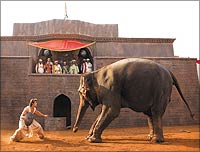
Shah Nadeem, a lecturer at Delhi’s Zakir Hussain College, who went to see the film reacted thus: “I was pleasantly surprised to see the kind of historical detail that went into the film. In Akbarnama, Abul Fazal refers to the emperor’s spiritual experience under a tree after which he gave himself the title of Insaan-e-Kamil. This is depicted onscreen as Akbar dancing to the song Khwaja Mere Khwaja in a trance. That apart, the killing of Aadam Khan by throwing him off twice from the pulpit, Akbar’s fascination to tame mad elephants are all historical facts. Of course, it’s all in filmy style but that’s ok.”
Which brings us to the same question, if not the audience, who do the shrill voices of protest belong to? Observes psephologist Yoginder Yadav, “With politics taking a communitarian turn, and with the young and infantile visual media looking for issues that are easy to turn into a story, the trouble makers are making merry.” Filmmakers too agree. Says Mishra, “There are too many vested groups in India. Who were these people before they started protesting?” Says Benegal: “Such protestors would want us to keep making fairytales so that they can use them to launch their political careers.”
Guiding history
But what about the lady in question? Says Najaf Haider, a professor of medieval history at JNU: “The whole concept of Jodha probably came into being in the 19th century from the stories of the tourist guides. They have a tremendous burden of narrating a story about each monument they show and often make up stories to fill gaps.” According to him, all three references to Akbar’s Rajput wife — in Abul Fazal’s Akbarnama when the Rajput marriage proposal comes, when Akbar gives her the title of Marian Zamani, and in Jahangir’s autobiography, Tuzuk-I-Jahangiri referring to his mother’s death — mentions no name. “But the fact that the Jodhpur princely house came into existence in the 17th century rules out the name Jodha in 16th century, when Akbar ruled,” says Haider.
Maximum mileage
With Bollywood emerging as a major newsmaker, these protests have become the easy way to hog limelight. Is there a solution to this problem? “To call the bluff of the protestors one should deal with it like a law and order issue. One tends to blame the people but it’s the politicians who are trying to make some capital out of it. It’s the most publicly displayable stunt at little cost,” Dipankar Gupta, the author of Interrogating Identity. Yadav puts his finger on the political pulse.
“One phenomenon that has been documented is that community identities are invented and discovered in the arena of politics through symbolism. Such protests should be seen in that context, and in Rajasthan with elections around the corner it’s all too obvious.”
Courtesy: hindustantimes.com
Showing posts with label Rajputs. Show all posts
Showing posts with label Rajputs. Show all posts
Tuesday, February 26, 2008


Sunday, February 17, 2008
Jodhaa Akbar not released in Rajasthan
Two long years in the making, with controversy hounding it, Jodha Akbar finally hit screens on Friday, and as per early reports it seems to be well worth the wait.
Gowarikar's magnum opus has not released in Rajasthan, after protests by some Rajput groups.
Cinema hall owners in Rajasthan were still unsure till Thursday about screening the movie amid aggressive protests.
Activists of the Karni Sena wrote letters in blood against the film's release and submitted it to theatre owners while Bollywood distributers were trying to pursuade them to call off their stir at the last minute.
Karni Sena patron Lokendra Kalvi said they would not stop the film but the Vasundhara Raje government would be held ''resposible'' if any untoward incidents occurred.
''The Rajputs cannot tolerate any distortion of historical facts, especially relations between the Mughal emporor Akbar and Jodhabai,'' he told reporters.
Anil Thadani, husband of actress Raveena Tandon who is also a well-known distributer for Mumbai territory, was holding talks with the Karni Sena.
Meanwhile, the Home Department has decided not to ban the Gowarikar's film and directed that law and order be maintained around all theatres of the state, Jaipur District Collector Khil Arora said.
The Rajasthan High Court had on Wednesday dismissed a petition seeking restraining orders against leaders of Rajput Sabha and Karni Sena but asked the government to ensure law and order
Courtesy: Ndtv.com
Thursday, February 14, 2008
'Filmmaking is not for the faint-hearted'
With Jodhaa Akbar ready to roll out across over 1,200 theatres worldwide -- at least 125 of them in North America -- distributor and co-producer UTV expects another breakthrough hit. For UTV Chairman Ronnie Screwvala, there cannot be any real business without calculated risks.

Ronnie Screwvala
Screwvala is emerging as the first India-based film producer to co-produce films in Hollywood with film companies associated with Sony and Fox Searchlight.
In India, he is steadily emerging as a producer with rare vision, courage and success. 'He is 'the frontrunner in the race to become Bollywood's Jack Warner -- the man who transformed parochial American cinema into its modern global form,' declared Newsweek recently.
In June, Screwvala's biggest Hollywood venture yet, the sci-fi film The Happening, directed by M Night Shyamalan, will roll out to more than 2500 theatres in North America.
What is special about Jodhaa Akbar?
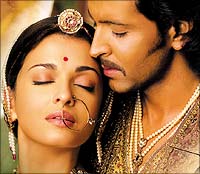
It is a visually stunning and superbly directed film about a little known aspect of Indian history. People know of Akbar, his rebellious son and Anarkali. People also know that Jodhaa was a Rajput wife of Akbar. But how many of us have known this great love story and the mystical bond between the two?
Aishwarya and Hrithik in Jodhaa AkbarSome people may say this is a period film, this is history and it may not be exciting...
The story of the film takes place in the 16th century but the film feels like a contemporary movie. It is a love story for our times. It was left to Ashutosh Gowariker to make a film of such huge magnitude and intensity that future generations may speak of Jodhaa and Akbar in the same breath they would talk about Akbar's rebellious son Salim and Anarkali, the dancing girl.
What is the buzz for the movie like?
I feel there is tremendous excitement for this film and for good reasons. Those who have seen the previews know they have glimpsed something unseen in Indian films. The word is out that the scale on which this film has been made is unprecedented. It is also Hrithik Roshan's first film in a year, and the audiences are expecting an excellent on screen chemistry between Aishwarya Rai Bachchan (Jodhaa) and Hrithik (Akbar). And people expect Ashu to have made a film even more engrossing and timely than his best work to date, Lagaan [Images].
But the film also runs more than three hours...
It has so much of intrigue and drama, apart from romance, that there would not be any dull moment in it. What is Ashu excellent is at telling a beautiful story while the spectacle unfolds and the screen is filled with great visuals and that is the biggest strength of the film.
Why will the film resonate with audiences today?
One of the reasons, we expect the film to reach wide audiences is due to the important fact that it is more of a love story than a historical film. It is not what you think as a traditional period or historical film. History serves as a backdrop to tell a marvelous story that looks not only at an unusual alliance between Jodhaa and Akbar but also at the religious, cultural and political issues of the times.
What would be some of the issues it addresses?
The film also deals with the issue of arranged marriage. Arranged marriages are quite common across India even today but how many of them are successful like that of Jodhaa and Akbar? The film could ignite new discussions about arranged marriages and love marriages. We expect people to come out of the screenings, talking a lot about the old times and their own lives.
There will be a lot of curiosity how the film opens.
I feel it is not going to be a two or three week phenomenon. It could become a long running hit.
What kind of repeat value does the film have?
We expect people to enjoy the spectacle and romance the first time they see the film. But we also expect many to return to the theatres a few days later to get more of the story, character developments and various underlying themes of the film.
Such things happen in the case of literary mystery books. People rush through the book for the suspense and then return to enjoy its language.
Certainly. Among the many films we have released some have had strong repeat audiences. Rang De Basanti [Images] was one. And I expect a similar reaction to Jodhaa Akbar, too.
Who would be the audience for Jodhaa Akbar abroad?
It will be playing primarily in the Diaspora market. But I would not be surprised if the word about the film gets out, and there would be some crossover audiences. It has the scale and appeal of a mainstream Hollywood film.
You have produced films like Jodhaa Akbar, The Namesake [Images], Life In A... Metro and Rang De Basanti that many others would have shunned or considered risky.
These are calculated risks. Once we are convinced -- and a lot depends on the script and the commitment of the director -- we greenlight the project within a few days. When Anurag Basu came to us with the proposal for Life In A ...Metro, we liked the concept immediately. I was fascinated that a band would be featured in the film and it would be used to propel the story. The gut feeling worked out to be true.
What would you tell younger filmmakers who are planning to produce or direct a film?
Always remember this: Filmmaking is not for the faint-hearted
You also sign a director to one or more films...
If I am convinced that the director I have signed -- whether a newcomer or a veteran -- is passionate about the project and is capable of streamlined production, it makes sense to have a bond that goes beyond one film. And that is why when Anurag Basu came to us with the idea of making Metro, I said, let us make more films with him.
Rakeysh Omprakash Mehra following Rang De Basanti is working on Dilli 6 and we are distributing the new film, too. We have made two films with Ashutosh Gowariker, Swades [Images] and Jodhaa Akbar. We released Aamir Khan's [Images] Taare Zameen Par [Images]. We are also releasing his next film as a producer though he is not in it; he did not direct it either.
Some directors including Basu and Mehra had made films which weren't successful before they approached UTV.
That tells something about the UTV philosophy. We don't really look at the past. Everything depends on the filmmaker's concept, script and commitment.
When someone like Mira Nair approaches with you with a project like The Namesake, which is based on a well-known book, do you make time to read the book?
I read the book, and, of course, I read the script. I have been telling those who had the fear that Mira may not do justice to the novel to see the film and read the book again or read it for the first time. I am sure you will end up appreciating the film better.
If you were to say in a few sentences what the driving philosophy behind UTV movies is...
We have made films that are beyond the song and dance routine. There are, of course, songs and dances in our films but they are truly situational and propel the story. We don't care for films which have songs for the sake of having them. We are looking at the bigger picture. And we are interested in being world players. Apart from the film projects we have signed with the production company of Will Smith [Images] and Chris Rock, we are also co-producing Night Shyamalan's film, The Happening.
You have often talked about transparency in business.
This is very important to me, and a small measure of this is reflected in the box-office grosses we put out, especially in North America and the United Kingdom, week after week. Just as Hollywood studios release the box-office information each weekend, we too do so, whether a film is a success or not.
Only a few movie companies in India seem to have your business concept when it comes to transparency.
There are good reasons for that kind of a business. Many films were -- and still are -- produced by family concerns. They looked at it as a cash flow business. We never really realise whether a film had made money or not because of lack of transparency. But at UTV we look at the films as a profit and loss business. We want accountability at every stage of the production and distribution.
You started your Hollywood career with a relatively low budget film, co-producing a Chris Rock comedy, I Think I Love My Wife (reportedly costing $12 million).
We are moving towards bigger budget films, too. We are clear on where we want to go. Our ambition is to be a global Indian entertainment company. And I don't see any reason why we can't make big-budget Hollywood films.
Do you think the kind of deals you are forging in Hollywood would have been possible two decades ago? You would have been expected to spend many months living in London [Images] or Hollywood then...
This is the age of globalisation. I come to Hollywood several times in a year. But given the rapid communication modes today, a lot of business can be done with Hollywood while one is in Bombay.
Courtesy: Rediff.com
Ronnie Screwvala
Screwvala is emerging as the first India-based film producer to co-produce films in Hollywood with film companies associated with Sony and Fox Searchlight.
In India, he is steadily emerging as a producer with rare vision, courage and success. 'He is 'the frontrunner in the race to become Bollywood's Jack Warner -- the man who transformed parochial American cinema into its modern global form,' declared Newsweek recently.
In June, Screwvala's biggest Hollywood venture yet, the sci-fi film The Happening, directed by M Night Shyamalan, will roll out to more than 2500 theatres in North America.
What is special about Jodhaa Akbar?
It is a visually stunning and superbly directed film about a little known aspect of Indian history. People know of Akbar, his rebellious son and Anarkali. People also know that Jodhaa was a Rajput wife of Akbar. But how many of us have known this great love story and the mystical bond between the two?
Aishwarya and Hrithik in Jodhaa AkbarSome people may say this is a period film, this is history and it may not be exciting...
The story of the film takes place in the 16th century but the film feels like a contemporary movie. It is a love story for our times. It was left to Ashutosh Gowariker to make a film of such huge magnitude and intensity that future generations may speak of Jodhaa and Akbar in the same breath they would talk about Akbar's rebellious son Salim and Anarkali, the dancing girl.
What is the buzz for the movie like?
I feel there is tremendous excitement for this film and for good reasons. Those who have seen the previews know they have glimpsed something unseen in Indian films. The word is out that the scale on which this film has been made is unprecedented. It is also Hrithik Roshan's first film in a year, and the audiences are expecting an excellent on screen chemistry between Aishwarya Rai Bachchan (Jodhaa) and Hrithik (Akbar). And people expect Ashu to have made a film even more engrossing and timely than his best work to date, Lagaan [Images].
But the film also runs more than three hours...
It has so much of intrigue and drama, apart from romance, that there would not be any dull moment in it. What is Ashu excellent is at telling a beautiful story while the spectacle unfolds and the screen is filled with great visuals and that is the biggest strength of the film.
Why will the film resonate with audiences today?
One of the reasons, we expect the film to reach wide audiences is due to the important fact that it is more of a love story than a historical film. It is not what you think as a traditional period or historical film. History serves as a backdrop to tell a marvelous story that looks not only at an unusual alliance between Jodhaa and Akbar but also at the religious, cultural and political issues of the times.
What would be some of the issues it addresses?
The film also deals with the issue of arranged marriage. Arranged marriages are quite common across India even today but how many of them are successful like that of Jodhaa and Akbar? The film could ignite new discussions about arranged marriages and love marriages. We expect people to come out of the screenings, talking a lot about the old times and their own lives.
There will be a lot of curiosity how the film opens.
I feel it is not going to be a two or three week phenomenon. It could become a long running hit.
What kind of repeat value does the film have?
We expect people to enjoy the spectacle and romance the first time they see the film. But we also expect many to return to the theatres a few days later to get more of the story, character developments and various underlying themes of the film.
Such things happen in the case of literary mystery books. People rush through the book for the suspense and then return to enjoy its language.
Certainly. Among the many films we have released some have had strong repeat audiences. Rang De Basanti [Images] was one. And I expect a similar reaction to Jodhaa Akbar, too.
Who would be the audience for Jodhaa Akbar abroad?
It will be playing primarily in the Diaspora market. But I would not be surprised if the word about the film gets out, and there would be some crossover audiences. It has the scale and appeal of a mainstream Hollywood film.
You have produced films like Jodhaa Akbar, The Namesake [Images], Life In A... Metro and Rang De Basanti that many others would have shunned or considered risky.
These are calculated risks. Once we are convinced -- and a lot depends on the script and the commitment of the director -- we greenlight the project within a few days. When Anurag Basu came to us with the proposal for Life In A ...Metro, we liked the concept immediately. I was fascinated that a band would be featured in the film and it would be used to propel the story. The gut feeling worked out to be true.
What would you tell younger filmmakers who are planning to produce or direct a film?
Always remember this: Filmmaking is not for the faint-hearted
You also sign a director to one or more films...
If I am convinced that the director I have signed -- whether a newcomer or a veteran -- is passionate about the project and is capable of streamlined production, it makes sense to have a bond that goes beyond one film. And that is why when Anurag Basu came to us with the idea of making Metro, I said, let us make more films with him.
Rakeysh Omprakash Mehra following Rang De Basanti is working on Dilli 6 and we are distributing the new film, too. We have made two films with Ashutosh Gowariker, Swades [Images] and Jodhaa Akbar. We released Aamir Khan's [Images] Taare Zameen Par [Images]. We are also releasing his next film as a producer though he is not in it; he did not direct it either.
Some directors including Basu and Mehra had made films which weren't successful before they approached UTV.
That tells something about the UTV philosophy. We don't really look at the past. Everything depends on the filmmaker's concept, script and commitment.
When someone like Mira Nair approaches with you with a project like The Namesake, which is based on a well-known book, do you make time to read the book?
I read the book, and, of course, I read the script. I have been telling those who had the fear that Mira may not do justice to the novel to see the film and read the book again or read it for the first time. I am sure you will end up appreciating the film better.
If you were to say in a few sentences what the driving philosophy behind UTV movies is...
We have made films that are beyond the song and dance routine. There are, of course, songs and dances in our films but they are truly situational and propel the story. We don't care for films which have songs for the sake of having them. We are looking at the bigger picture. And we are interested in being world players. Apart from the film projects we have signed with the production company of Will Smith [Images] and Chris Rock, we are also co-producing Night Shyamalan's film, The Happening.
You have often talked about transparency in business.
This is very important to me, and a small measure of this is reflected in the box-office grosses we put out, especially in North America and the United Kingdom, week after week. Just as Hollywood studios release the box-office information each weekend, we too do so, whether a film is a success or not.
Only a few movie companies in India seem to have your business concept when it comes to transparency.
There are good reasons for that kind of a business. Many films were -- and still are -- produced by family concerns. They looked at it as a cash flow business. We never really realise whether a film had made money or not because of lack of transparency. But at UTV we look at the films as a profit and loss business. We want accountability at every stage of the production and distribution.
You started your Hollywood career with a relatively low budget film, co-producing a Chris Rock comedy, I Think I Love My Wife (reportedly costing $12 million).
We are moving towards bigger budget films, too. We are clear on where we want to go. Our ambition is to be a global Indian entertainment company. And I don't see any reason why we can't make big-budget Hollywood films.
Do you think the kind of deals you are forging in Hollywood would have been possible two decades ago? You would have been expected to spend many months living in London [Images] or Hollywood then...
This is the age of globalisation. I come to Hollywood several times in a year. But given the rapid communication modes today, a lot of business can be done with Hollywood while one is in Bombay.
Courtesy: Rediff.com
NRI groups call for boycott of Jodha Akbar movie
With historians having differences on Princess Jodha Bai, some NRI groups have joined the protest against the screening of Bollywood movie Jodhaa Akbar , saying it "grossly distorts" Indian history.
In a press release here, the groups said that they considered these "distortions to be extremely insensitive and it hurts the sentiments of millions of people who love the culture, history and traditions of India."
Calling for a boycott of the movie directed by Ashutosh Gowarikar, the supporters of the campaign-led by Rajput Karni Sena said while this film may be fictional in nature, but a mere disclaimer of 30 seconds or so at the beginning of a movie rarely gets registered in the mind of the moviegoer.
"It is the main movie, its story and the events it depicts that leave a lasting imprint."
The groups joining the campaign include Agni Foundation; the Netherlands, Global Institute for Truth & Awareness (GITA), USA; Hindi USA; Independent NRI Forum, USA; Kashmir Task Force, USA; Save Temples, USA.
"Some people have asked whether even a Bollywood movie can seriously damage a culture of billion people. No, in the long run, it cannot. But that is not the point. The real concern of the campaign is for each and every person," said Naresh Sharma of Global Institute for Truth & Awareness.
Supporters of the campaign say that the depiction of romance between 'Akbar' and 'Jodhaa' prior to their marriage is a total concoction because based on historical records and contrary to what the film projects, nobody called 'Jodhaa' has ever been associated with Jalaluddin, later called Akbar. In fact, there is no mention of 'Jodhaa' in the historical records prepared by Akbar's own historian Abul Fazl.
Courtesy: Indiatimes.com
Tamil theaters supporting the Rajasthani Rajputs against Jodha Akbar?
Unlike what was being reported earlier, Jodha Akbar will not be able to make it in dubbed versions in Tamil Nadu this week. 'Officially' the Tamil distributors are believed to have told the makers the demand is not strong enough for it to follow the likes of Krrish, Dhoom 2 and Guru to have a regional sub-release also in the south. However it could be they are heeding the calls of the Hindu Rajput groups who have asked people of every state to shun the film because of what is being called an attempt to distort Indian & Hindu history via a movie.
The other aspect could be purely financial. UTV is said to have asked for over 2 crores for the territory which is believed to be too much given its theme and setting at the moment.
Even the Hindi version in Chennai is not having a huge release with only 2 theaters currently planning to exhibit the mughal-rajput saga on Friday.
Courtesy: Ibosnetwork.com
Case against Jodha... in Patna court
The protest against Hindi film Jodha Akbar, to be released nationwide on Friday next, reached here and a case has been filed to stop the release of the movie directed by Ashutosh Gowarikar. On Tuesday, one Thakur Devendra Singh, claiming president of Bihar State Chhatriya Mahasabha, filed a case in the court of the CJM, Patna.
In the petition filed through his pleader V P Mishra, Singh said the film was a distortion of history and an insult on the Rajput community. Quoting history, he said in the harem of emperor Akbar, there was no woman called Jodha among 5,000 women. He claimed it was an attempt to publicise a historically incorrect incident and mislead the people which was a cognizable offence.
Singh said, in the portal of the film, it has been claimed that it was a romance between two different cultures.
Courtesy: Indiatimes.com
Wednesday, February 13, 2008
Debate continues over Jodha Bai
Who was Jodha Bai? That's the crux of the controversy that's dogging Ashutosh Gowarikar magnum opus Jodha Akbar that releases this week.
A section of the Rajput community opposing the film claims that it's historically incorrect to say that Jodha was Akbar's wife but historians themselves are divided.
Some historians say Jodhaa was Akbar's daughter-in-law, which is what school textbooks also say but others claim she was married to Akbar.
In fact she was not a Jaipur princess at all but from Jodhpur and wife of Salim or Jehangir.
They claim, the Jaipur Princess Akbar was married to, was called Harkan or Heera Bai but coming out in support of the film is none other than the royal families of Jaipur and Kishangarh.
The royal families say there is not much in a name. Akbar's consort was a Jaipur princess and Gowarikar only went ahead with the film once they cleared the script and if anybody has any objections it should be them.
While school children studying Satish Chandra 's NCERT text book are taught that Jodha Bai was the wife of Jehangir other historians claim that in fact if you look at primary sources there is no mention of the name Jodha at all.
In fact the name Jodha only crops up in the past 200 years when Col Todd in his annals and antiquities of Rajasthan writes that Jodha was probably married to Akbar. So the mystery deepens as to who was Jodha?
The Mughals came to India as invaders but it was Akbar who embraced Hindustan as his own. His marriage with the daughter of Rajput kings of Amber was a political alliance that turned the Rajputs from foes into friends.
But who was this princess who entered into the first Hindu-Muslim alliance in history?
Original records like Ain-I-Akbari and histories of the Amber kings confirm that in 1562 Akbar married Raja Bharmal's daughter at Sambhar about a 100 km from modern Jaipur but the name of this princess is far from clear.
"Our geneology, the documents of the Royal Family are the most authentic records, and in our records, different names appear. She is called Hira Bai and Harkan Bai and some historians call her Jodha. So he took the most popular name for the film," said Maharaja Brajraj Singh, Kishangarh Royal family.
But Ashutosh Gowarikar says the film should not be judged only in the context of the title but as an exploration of an inter-faith relationship.
"For me what became important was to get into the research. I read the Rajput history-some called her Harka Bai, Shahi Bai, Jodha Bai. I also read the history of Jaipur, where it mentions Uday Singh the Raja, who gave his daughter away to Jehangir but her name was Jodh. Both Jodha and Jodh are different I could have called my film Harka-Akbar or Meera-Akbar but I thought some historians might object to it so I kept the popular name," said Gowarikar.
So, how did the name Jodha become popular?
Some historians like Col Todd have called Akbar's wife Jodha and Films like Mughal-e-Azam, which picked up the name entrenched it in public memory.
But the Rajput community that's opposing the film says the time has now come to set the record straight. They claim Jodha was from Jodhpur and she was married not to Akbar but to his son Jehangir.
Prof Khangarot, Historian and spokespeson for the Rajput sabha said, "Do you have a right to make your own history or change history. Jodha Bai was the daughter of Mota Raja of Jodhpur, who wed Salim and became the mother of Shahjahan."
The Rajput Karni Sena has already started burning posters of the film. They say they won't allow it to be shown in Rajasthan. But the Jaipur royals, who support the film say Gowarikar's has depicted Rajput culture with sensitivity.
Maharani Padmini Devi, Jaipur royal family said, "We went through the script before he started the movie, the mahurat shot was taken here. We are the closest in relation to Jodha, therefore if there was anything objectionable we would have not endorsed it."
Some historians are of the opinion that the name Jodha does not figure in any original records of the time.
Infact, it is only in the past 200 years that the name begins to appear in historical narratives. So what is history?
There is no definite answer, there is recorded history and there are oral traditions, there are legends and myths. The the answers to who was Jodha probably lies in the matrix of our past.
Courtesy: Ndtvmovies.com
Monday, February 11, 2008
Controversy and Bollywood's versions of Indian history go hand in hand
Controversy and Bollywood's versions of Indian history seem to go hand in hand. HIMANSHU BHAGAT talks to some historians to find out why
Factually at least, they are on solid ground. Akbar never married Jodha Bai. It was his son, Prince Salim who did. Salim became Emperor Jehangir. And his son from Jodha Bai, Prince Khurram, succeeded his father as Emperor Shah Jahan. “All this goes to show that history is not settled business,” says Mahmood Farooqui, who is currently writing a book on 1857 but is better known as a dastango who has single-handedly revived dastangoi or the traditional art of oral storytelling in Delhi. “It is almost as if each generation has its own myths about the past.” “Those protesting the movie have two specific objections,” says Dilbag Singh, professor of Mughal history at the Jawaharlal Nehru University in New Delhi. “That a different person was married to Akbar. And, that there was no love affair between the two.” Iqtidar Alam Khan, the noted historian and authority on Akbar who teaches at Aligarh Muslim University, points out that Akbar did marry a Rajput princess but she was Harka Bai, daughter of the Kachwaha ruler of Amber, Raja Bharmal. “The erroneous tradition that Akbar was married to Jodha Bai can be traced back at least to the 18th century. That is when we find the first written reference to it,” he says.
Shah Nadeem, who teaches history at Zakir Husain College in Delhi University, also points out that one of the palaces at Fatehpur Sikri, the city built by Akbar near Agra, is called Jodha Mahal, and is one reason why Jodha Bai is popularly believed to have been Akbar's queen. But why should getting Akbar's Rajput wife's name wrong touch a raw nerve? Is there some latent sense of communal grievance behind the protest? Singh can't see why the Rajputs should harbour any grudge against the Mughals. As he points out, the tradition of intermarriage among ruling families as a means to achieve political stability and forge new ties is an old one. Rajput princesses were married to Muslim sultans in Delhi and Gujarat during the pre-Mughal era. “The Mughals merely systematised this tradition. Akbar was the first Mughal emperor to marry a Rajput princess,” says Singh. “From the time of Shah Jahan, the practise of establishing matrimonial ties between the Mughals and the Rajputs declined. It is no coincidence that, around the same time, the Mughals had achieved a healthy degree of political stability.” And the Rajputs had no qualms about intermarriage with the Mughals. Khan feels people often forget that the medieval world was very different from ours, with different attitudes and outlook. “The Rajputs wouldn't have seen the Mughals as 'outsiders', for the idea of India as a nation didn't exist at the time,” he says. “In matters related to marriage, caste pride played a bigger role. The Rajputs, for instance, would never have married into communities they felt were lower in the caste hierarchy.” Whether it is a film based on the life of Mangal Pandey, or one on Bhagat Singh, or one that depicts the plight of widows a hundred years ago (Deepa Mehta's Water) - in India, films based on historical themes inevitably become controversial.
This also holds true for books on historical figures like Shivaji, Nehru or Netaji Subhash Chandra Bose. Questions about Shivaji's parentage incense some; others object to a close examination of Nehru's relationship with Edwina Mountbatten or of Netaji's links with Hitler. Perhaps the phenomenon is an indicator of the fact that India is “a land of million mutinies” where castes, community and regional groupings feel the need to assert their identity for a number of reasons. And history is the key to identity.
“In England, there is the historical [Queen] Elizabeth [the First] and there is the popular Elizabeth. There is a consensus about her there,” says Mahmood Farooqui. “But there is no consensus here. If you make a film on Ambedkar or on Bhagat Singh supporters of Gandhi are likely to object. And it can go the other way round.” Singh points out that in India, group identities play a larger role in the individual's psyche as compared to the West. “Mughal court historians referred to Jats as plunderers and even today the Jat community resents that,” he says. “They were actually farmers - peasant proprietors and zamindars - who resisted Mughal power.” Farooqui feels that an artist must be mindful of these realities. His current dastan (story) is set during the Partition and features a street poem from a time that is very critical of Nehru. “There is no such thing as absolute freedom of speech,” he says. “You can go to certain extent but not beyond that.” What bothers most historians is the cavalier fashion in which films and television in India treat history. They appreciate that a film is meant to entertain and not serve as a history lesson.

But there are ways of going about it. “The television serial Prithviraj Chauhan, which is being aired currently is one hundred percent fiction,” says an indignant Singh. Shah can cite any number of instances where “Bollywood's fetish for love affairs” means that facts mean nothing. He points out that contrary to what the film Razia Sultana depicts, the real Razia - the only woman ruler of the Delhi Sultanate - did not fall in love with the Abyssinian noble Yaqut. He also cites the SRKstarrer Asoka as a poorly researched film littered with factual inaccuracies. “In case you don't already know, Ashoka didn't attack Kalinga because he was in love with a girl,” he says. There is a reason why he feels strongly about this. “Some accuracy and a basic adherence to facts are necessary because films and TV have a hold on the popular imagination and shape perceptions,” he says.
There are examples which filmmakers can learn from. “A good historical film is Satyajit Ray's adaptation of Premchand's novella Shatranj Ke Khiladi,” says Shah. “The tale of two chess-playing noblemen during the last days of Awadh is completely fictional. But the setting is authentic and historically accurate. The film gave a true picture of Awadh during the tumult of 1856 and its last Nawab, Wajid Ali Shah.” The mix of history, folklore and outright fantasy can make for good entertainment but a more discerning viewership, as well as one that is quick to take offence, will ensure that film directors think twice before they decide to set their next love story in the 16th century.
Courtesy: Indiafm.com

Factually at least, they are on solid ground. Akbar never married Jodha Bai. It was his son, Prince Salim who did. Salim became Emperor Jehangir. And his son from Jodha Bai, Prince Khurram, succeeded his father as Emperor Shah Jahan. “All this goes to show that history is not settled business,” says Mahmood Farooqui, who is currently writing a book on 1857 but is better known as a dastango who has single-handedly revived dastangoi or the traditional art of oral storytelling in Delhi. “It is almost as if each generation has its own myths about the past.” “Those protesting the movie have two specific objections,” says Dilbag Singh, professor of Mughal history at the Jawaharlal Nehru University in New Delhi. “That a different person was married to Akbar. And, that there was no love affair between the two.” Iqtidar Alam Khan, the noted historian and authority on Akbar who teaches at Aligarh Muslim University, points out that Akbar did marry a Rajput princess but she was Harka Bai, daughter of the Kachwaha ruler of Amber, Raja Bharmal. “The erroneous tradition that Akbar was married to Jodha Bai can be traced back at least to the 18th century. That is when we find the first written reference to it,” he says.
Shah Nadeem, who teaches history at Zakir Husain College in Delhi University, also points out that one of the palaces at Fatehpur Sikri, the city built by Akbar near Agra, is called Jodha Mahal, and is one reason why Jodha Bai is popularly believed to have been Akbar's queen. But why should getting Akbar's Rajput wife's name wrong touch a raw nerve? Is there some latent sense of communal grievance behind the protest? Singh can't see why the Rajputs should harbour any grudge against the Mughals. As he points out, the tradition of intermarriage among ruling families as a means to achieve political stability and forge new ties is an old one. Rajput princesses were married to Muslim sultans in Delhi and Gujarat during the pre-Mughal era. “The Mughals merely systematised this tradition. Akbar was the first Mughal emperor to marry a Rajput princess,” says Singh. “From the time of Shah Jahan, the practise of establishing matrimonial ties between the Mughals and the Rajputs declined. It is no coincidence that, around the same time, the Mughals had achieved a healthy degree of political stability.” And the Rajputs had no qualms about intermarriage with the Mughals. Khan feels people often forget that the medieval world was very different from ours, with different attitudes and outlook. “The Rajputs wouldn't have seen the Mughals as 'outsiders', for the idea of India as a nation didn't exist at the time,” he says. “In matters related to marriage, caste pride played a bigger role. The Rajputs, for instance, would never have married into communities they felt were lower in the caste hierarchy.” Whether it is a film based on the life of Mangal Pandey, or one on Bhagat Singh, or one that depicts the plight of widows a hundred years ago (Deepa Mehta's Water) - in India, films based on historical themes inevitably become controversial.
This also holds true for books on historical figures like Shivaji, Nehru or Netaji Subhash Chandra Bose. Questions about Shivaji's parentage incense some; others object to a close examination of Nehru's relationship with Edwina Mountbatten or of Netaji's links with Hitler. Perhaps the phenomenon is an indicator of the fact that India is “a land of million mutinies” where castes, community and regional groupings feel the need to assert their identity for a number of reasons. And history is the key to identity.
“In England, there is the historical [Queen] Elizabeth [the First] and there is the popular Elizabeth. There is a consensus about her there,” says Mahmood Farooqui. “But there is no consensus here. If you make a film on Ambedkar or on Bhagat Singh supporters of Gandhi are likely to object. And it can go the other way round.” Singh points out that in India, group identities play a larger role in the individual's psyche as compared to the West. “Mughal court historians referred to Jats as plunderers and even today the Jat community resents that,” he says. “They were actually farmers - peasant proprietors and zamindars - who resisted Mughal power.” Farooqui feels that an artist must be mindful of these realities. His current dastan (story) is set during the Partition and features a street poem from a time that is very critical of Nehru. “There is no such thing as absolute freedom of speech,” he says. “You can go to certain extent but not beyond that.” What bothers most historians is the cavalier fashion in which films and television in India treat history. They appreciate that a film is meant to entertain and not serve as a history lesson.
But there are ways of going about it. “The television serial Prithviraj Chauhan, which is being aired currently is one hundred percent fiction,” says an indignant Singh. Shah can cite any number of instances where “Bollywood's fetish for love affairs” means that facts mean nothing. He points out that contrary to what the film Razia Sultana depicts, the real Razia - the only woman ruler of the Delhi Sultanate - did not fall in love with the Abyssinian noble Yaqut. He also cites the SRKstarrer Asoka as a poorly researched film littered with factual inaccuracies. “In case you don't already know, Ashoka didn't attack Kalinga because he was in love with a girl,” he says. There is a reason why he feels strongly about this. “Some accuracy and a basic adherence to facts are necessary because films and TV have a hold on the popular imagination and shape perceptions,” he says.
There are examples which filmmakers can learn from. “A good historical film is Satyajit Ray's adaptation of Premchand's novella Shatranj Ke Khiladi,” says Shah. “The tale of two chess-playing noblemen during the last days of Awadh is completely fictional. But the setting is authentic and historically accurate. The film gave a true picture of Awadh during the tumult of 1856 and its last Nawab, Wajid Ali Shah.” The mix of history, folklore and outright fantasy can make for good entertainment but a more discerning viewership, as well as one that is quick to take offence, will ensure that film directors think twice before they decide to set their next love story in the 16th century.
Courtesy: Indiafm.com
Sunday, February 10, 2008
Now Nasik engages against 'Akbar'
Following the call of the Rajasthan Rajputs, Hindu community in Nasik, Maharashtra has emerged first non-Rajasthani crew to provide backup to the Karni Sena and Rajput Sabha of Rajasthan and demanded that the Censor Board of India appoint a Committee of Rajputs to screen the forthcoming Ashutosh Gowarikar movie Jodha Akbar before it is allowed to release.
In a warning pamphlet by Ratandeep Shisodia, Founding Member of Kranti Sanstha in Nasik, it has been stated that numerous facts have been distorted in the film. They want the film to highlight that there was no Jodhaa Bai wife of Akbar and that a Jodha was daughter of a slave girl in the harem of Akbar who was eventually married off to Akbar’s son Jehangir, implying that a Jodha Bai of the harem was the daughter-in-law of Akbar not his wife.
Notwithstanding which, they are planning to block Jodha Akbar starting from Nasik across Maharashtra also.
Courtesy: Ibosnetwork.com
Subscribe to:
Posts (Atom)